Our Daughters Foundation
Privacy Policy - Our Daughters Foundation
Last Updated: June 19, 2025
Our Daughters Foundation ("we," "us," or "our") is committed to protecting the privacy and security of the personal information we collect from our website visitors, donors, grant applicants, and all individuals who interact with us. This Privacy Policy outlines how we collect, use, disclose, and protect your information.
By visiting our website, engaging with our services, or making a donation, you agree to the terms of this Privacy Policy.
Privacy Policy - Our Daughters Foundation
Last Updated: June 19, 2025
Our Daughters Foundation ("we," "us," or "our") is committed to protecting the privacy and security of the personal information we collect from our website visitors, donors, grant applicants, and all individuals who interact with us. This Privacy Policy outlines how we collect, use, disclose, and protect your information.
By visiting our website, engaging with our services, or making a donation, you agree to the terms of this Privacy Policy.
1. Who We Are
Our Daughters Foundation exists to raise awareness, support research, and provide compassionate grants to women impacted by complex hormonal illnesses. Our mission is rooted in prayer, guided by compassion, and fueled by the belief that no woman should have to suffer in silence or carry the burden alone. We’re here to walk alongside the daughters, mothers, sisters, and friends who are still searching for hope—and to be sure they feel seen & supported.
2. Information We Collect
We collect various types of information to support our mission and provide our services. This may include:
a. Information You Provide Directly:
• Contact Information: Name, email address, phone number, mailing address. This is typically collected when you fill out contact forms, subscribe to newsletters, or make inquiries.
• Donation Information: In addition to contact information, we collect donation amounts and payment details. Please note: Payment processing for donations is handled by secure third-party payment processors (e.g., Stripe). We do not directly store your credit card or sensitive banking information on our servers.
• Grant Application Information: If you apply for a grant, we may collect more detailed personal and health-related information as necessary to evaluate your application. This may include health conditions, medical history, and financial information. This sensitive data is handled with the utmost care and confidentiality.
• Communication Content: Any information you provide when communicating with us via email, phone, or other channels.
b. Information Collected Automatically (Website Usage Data):
When you visit our website, we may automatically collect certain information about your device and browsing activity, including:
• IP Address: To understand geographic location and help prevent fraud.
• Browser Type and Version: For website optimization and debugging.
• Operating System: For website compatibility and optimization.
• Referring/Exit Pages: To understand how users navigate to and from our site.
• Date and Time of Visit: For traffic analysis.
• Pages Viewed: To understand popular content and user interests.
• Clickstream Data: Information about how you interact with our website.
• Cookies and Tracking Technologies: We use cookies and similar technologies (like pixels and web beacons) to enhance your browsing experience, analyze site traffic, personalize content, and serve relevant advertisements. You can manage your cookie preferences through your browser settings.
3. How We Use Your Information
We use the information we collect for the following purposes:
• To Fulfill Our Mission: To process donations, evaluate grant applications, and administer grants.
• To Communicate With You: To respond to your inquiries, send newsletters, updates, and donation receipts, and provide information about our programs and events.
• To Improve Our Services: To analyze website usage, understand user needs, and enhance our website's functionality, content, and user experience.
• For Fundraising and Engagement: To inform you about ways to support Our Daughters Foundation, including fundraising campaigns and volunteer opportunities.
• For Legal and Security Purposes: To comply with legal obligations, enforce our terms and policies, prevent fraud, and protect the security and integrity of our website and data.
• For Research and Awareness: To inform our awareness campaigns and research advocacy efforts (always using aggregated or anonymized data where possible to protect individual privacy).
4. How We Share Your Information
We do not sell, rent, or trade your personal information to third parties. We may share your information in the following limited circumstances:
• With Service Providers: We may share information with trusted third-party service providers who assist us in operating our website, processing donations, managing communications, conducting research, or providing other services on our behalf (e.g., payment processors, email service providers, analytics providers). These providers are contractually obligated to protect your information and use it only for the purposes for which it was shared.
• With Grant Reviewers/Committees: For grant applications, relevant information may be shared with our internal grant review committees or external experts involved in the evaluation process, strictly for the purpose of assessing eligibility and need.
• For Legal Reasons: We may disclose your information if required by law, subpoena, or other legal process, or if we reasonably believe that such action is necessary to (a) comply with the law and the reasonable requests of law enforcement; (b) enforce our Terms of Use or to protect the security or integrity of our Service; and/or (c) exercise or protect the rights, property, or personal safety of Our Daughters Foundation, our users, or others.
• With Your Consent: We may share your information with third parties when we have your explicit consent to do so.
Aggregated or Anonymized Data: We may share aggregated or anonymized data (which cannot be used to identify you personally) for research, analytical, or public awareness purposes.
5. Data Security
We implement reasonable administrative, technical, and physical safeguards designed to protect your personal information from unauthorized access, use, alteration, and disclosure. However, no method of transmission over the Internet or electronic storage is 100% secure. Therefore, while we strive to protect your personal information, we cannot guarantee its absolute security.
6. Data Retention
We retain personal information for as long as necessary to fulfill the purposes for which it was collected, to comply with our legal obligations, resolve disputes, and enforce our agreements.
7. Your Rights and Choices
Depending on your jurisdiction, you may have certain rights regarding your personal information, including:
• Access: The right to request access to the personal information we hold about you.
• Correction/Rectification: The right to request correction of inaccurate or incomplete information.
• Deletion/Erasure: The right to request deletion of your personal information, subject to certain legal exceptions.
• Objection/Restriction: The right to object to or request restriction of our processing of your personal information.
• Data Portability: The right to receive a copy of your personal information in a structured, commonly used, and machine-readable format.
• Opt-out of Marketing Communications: You can opt-out of receiving marketing or promotional emails from us by following the unsubscribe instructions provided in those emails. Please note that even if you opt-out of marketing communications, we may still send you transactional or administrative messages related to your donations or inquiries.
To exercise any of these rights, please contact us using the contact information provided below.
8. Children's Privacy
Our website and services are not intended for children under the age of 13. We do not knowingly collect personal information from children under 13. If we become aware that we have inadvertently received personal information from a child under 13, we will delete such information from our records.
9. Links to Other Websites
Our website may contain links to third-party websites. This Privacy Policy does not apply to the practices of other websites, and we are not responsible for the content or privacy practices of those sites. We encourage you to review the privacy policies of any third-party sites you visit.
10. Changes to This Privacy Policy
We may update this Privacy Policy from time to time to reflect changes in our practices or for other operational, legal, or regulatory reasons. We will post the updated Privacy Policy on this page with a revised "Last Updated" date. We encourage you to review this Privacy Policy periodically. Your continued use of our website or services after any changes indicates your acceptance of the updated policy.
Disclaimer: This Privacy Policy is a sample and provided for informational purposes only. It should not be considered legal advice. It is highly recommended that you consult with a legal professional to ensure your Privacy Policy complies with all applicable laws and regulations relevant to your specific location and activities (e.g., GDPR, CCPA, HIPAA if handling protected health information, etc.).
1. Who We Are
Our Daughters Foundation exists to raise awareness, support research, and provide compassionate grants to women impacted by complex hormonal illnesses. Our mission is rooted in prayer, guided by compassion, and fueled by the belief that no woman should have to suffer in silence or carry the burden alone. We’re here to walk alongside the daughters, mothers, sisters, and friends who are still searching for hope—and to be sure they feel seen & supported.
2. Information We Collect
We collect various types of information to support our mission and provide our services. This may include:
a. Information You Provide Directly:
• Contact Information: Name, email address, phone number, mailing address. This is typically collected when you fill out contact forms, subscribe to newsletters, or make inquiries.
• Donation Information: In addition to contact information, we collect donation amounts and payment details. Please note: Payment processing for donations is handled by secure third-party payment processors (e.g., Stripe). We do not directly store your credit card or sensitive banking information on our servers.
• Grant Application Information: If you apply for a grant, we may collect more detailed personal and health-related information as necessary to evaluate your application. This may include health conditions, medical history, and financial information. This sensitive data is handled with the utmost care and confidentiality.
• Communication Content: Any information you provide when communicating with us via email, phone, or other channels.
b. Information Collected Automatically (Website Usage Data):
When you visit our website, we may automatically collect certain information about your device and browsing activity, including:
• IP Address: To understand geographic location and help prevent fraud.
• Browser Type and Version: For website optimization and debugging.
• Operating System: For website compatibility and optimization.
• Referring/Exit Pages: To understand how users navigate to and from our site.
• Date and Time of Visit: For traffic analysis.
• Pages Viewed: To understand popular content and user interests.
• Clickstream Data: Information about how you interact with our website.
• Cookies and Tracking Technologies: We use cookies and similar technologies (like pixels and web beacons) to enhance your browsing experience, analyze site traffic, personalize content, and serve relevant advertisements. You can manage your cookie preferences through your browser settings.
3. How We Use Your Information
We use the information we collect for the following purposes:
• To Fulfill Our Mission: To process donations, evaluate grant applications, and administer grants.
• To Communicate With You: To respond to your inquiries, send newsletters, updates, and donation receipts, and provide information about our programs and events.
• To Improve Our Services: To analyze website usage, understand user needs, and enhance our website's functionality, content, and user experience.
• For Fundraising and Engagement: To inform you about ways to support Our Daughters Foundation, including fundraising campaigns and volunteer opportunities.
• For Legal and Security Purposes: To comply with legal obligations, enforce our terms and policies, prevent fraud, and protect the security and integrity of our website and data.
• For Research and Awareness: To inform our awareness campaigns and research advocacy efforts (always using aggregated or anonymized data where possible to protect individual privacy).
4. How We Share Your Information
We do not sell, rent, or trade your personal information to third parties. We may share your information in the following limited circumstances:
• With Service Providers: We may share information with trusted third-party service providers who assist us in operating our website, processing donations, managing communications, conducting research, or providing other services on our behalf (e.g., payment processors, email service providers, analytics providers). These providers are contractually obligated to protect your information and use it only for the purposes for which it was shared.
• With Grant Reviewers/Committees: For grant applications, relevant information may be shared with our internal grant review committees or external experts involved in the evaluation process, strictly for the purpose of assessing eligibility and need.
• For Legal Reasons: We may disclose your information if required by law, subpoena, or other legal process, or if we reasonably believe that such action is necessary to (a) comply with the law and the reasonable requests of law enforcement; (b) enforce our Terms of Use or to protect the security or integrity of our Service; and/or (c) exercise or protect the rights, property, or personal safety of Our Daughters Foundation, our users, or others.
• With Your Consent: We may share your information with third parties when we have your explicit consent to do so.
Aggregated or Anonymized Data: We may share aggregated or anonymized data (which cannot be used to identify you personally) for research, analytical, or public awareness purposes.
5. Data Security
We implement reasonable administrative, technical, and physical safeguards designed to protect your personal information from unauthorized access, use, alteration, and disclosure. However, no method of transmission over the Internet or electronic storage is 100% secure. Therefore, while we strive to protect your personal information, we cannot guarantee its absolute security.
6. Data Retention
We retain personal information for as long as necessary to fulfill the purposes for which it was collected, to comply with our legal obligations, resolve disputes, and enforce our agreements.
7. Your Rights and Choices
Depending on your jurisdiction, you may have certain rights regarding your personal information, including:
• Access: The right to request access to the personal information we hold about you.
• Correction/Rectification: The right to request correction of inaccurate or incomplete information.
• Deletion/Erasure: The right to request deletion of your personal information, subject to certain legal exceptions.
• Objection/Restriction: The right to object to or request restriction of our processing of your personal information.
• Data Portability: The right to receive a copy of your personal information in a structured, commonly used, and machine-readable format.
• Opt-out of Marketing Communications: You can opt-out of receiving marketing or promotional emails from us by following the unsubscribe instructions provided in those emails. Please note that even if you opt-out of marketing communications, we may still send you transactional or administrative messages related to your donations or inquiries.
To exercise any of these rights, please contact us using the contact information provided below.
8. Children's Privacy
Our website and services are not intended for children under the age of 13. We do not knowingly collect personal information from children under 13. If we become aware that we have inadvertently received personal information from a child under 13, we will delete such information from our records.
9. Links to Other Websites
Our website may contain links to third-party websites. This Privacy Policy does not apply to the practices of other websites, and we are not responsible for the content or privacy practices of those sites. We encourage you to review the privacy policies of any third-party sites you visit.
10. Changes to This Privacy Policy
We may update this Privacy Policy from time to time to reflect changes in our practices or for other operational, legal, or regulatory reasons. We will post the updated Privacy Policy on this page with a revised "Last Updated" date. We encourage you to review this Privacy Policy periodically. Your continued use of our website or services after any changes indicates your acceptance of the updated policy.
Disclaimer: This Privacy Policy is a sample and provided for informational purposes only. It should not be considered legal advice. It is highly recommended that you consult with a legal professional to ensure your Privacy Policy complies with all applicable laws and regulations relevant to your specific location and activities (e.g., GDPR, CCPA, HIPAA if handling protected health information, etc.).
Join Us: Make a Difference Today
Your support can transform lives. Every donation helps us fund research, advocate for better care, and provide essential grants to women facing debilitating conditions.
Join Us: Make a Difference Today
Your support can transform lives. Every donation helps us fund research, advocate for better care, and provide essential grants to women facing debilitating conditions.


Faith, the Nervous System & the Biology of Chronic Stress
Faith, the Nervous System, & the Biology of Chronic Stress
The more I study neuroscience and the ties to chronic illness/pain, the more I recognize the intersection between neuroscience and my Christian faith. The Bible repeatedly calls us toward peace, hope, truth, rest, love, gratitude, and trust. Modern neuroscience and psychoneuroimmunology are increasingly showing that these states also affect the body in measurable ways.
This does not mean Christianity is simply a nervous system strategy, nor does it mean faith guarantees physical healing. Scripture never promises that believers will avoid suffering, illness, grief, or pain. But what both Scripture and science increasingly seem to affirm is that human beings were created as deeply integrated creatures. Our thoughts, emotions, beliefs, relationships, stress responses, immune systems, and nervous systems constantly interact with one another.
The more we learn about chronic stress and the nervous system, the more remarkable many biblical principles begin to look to me.
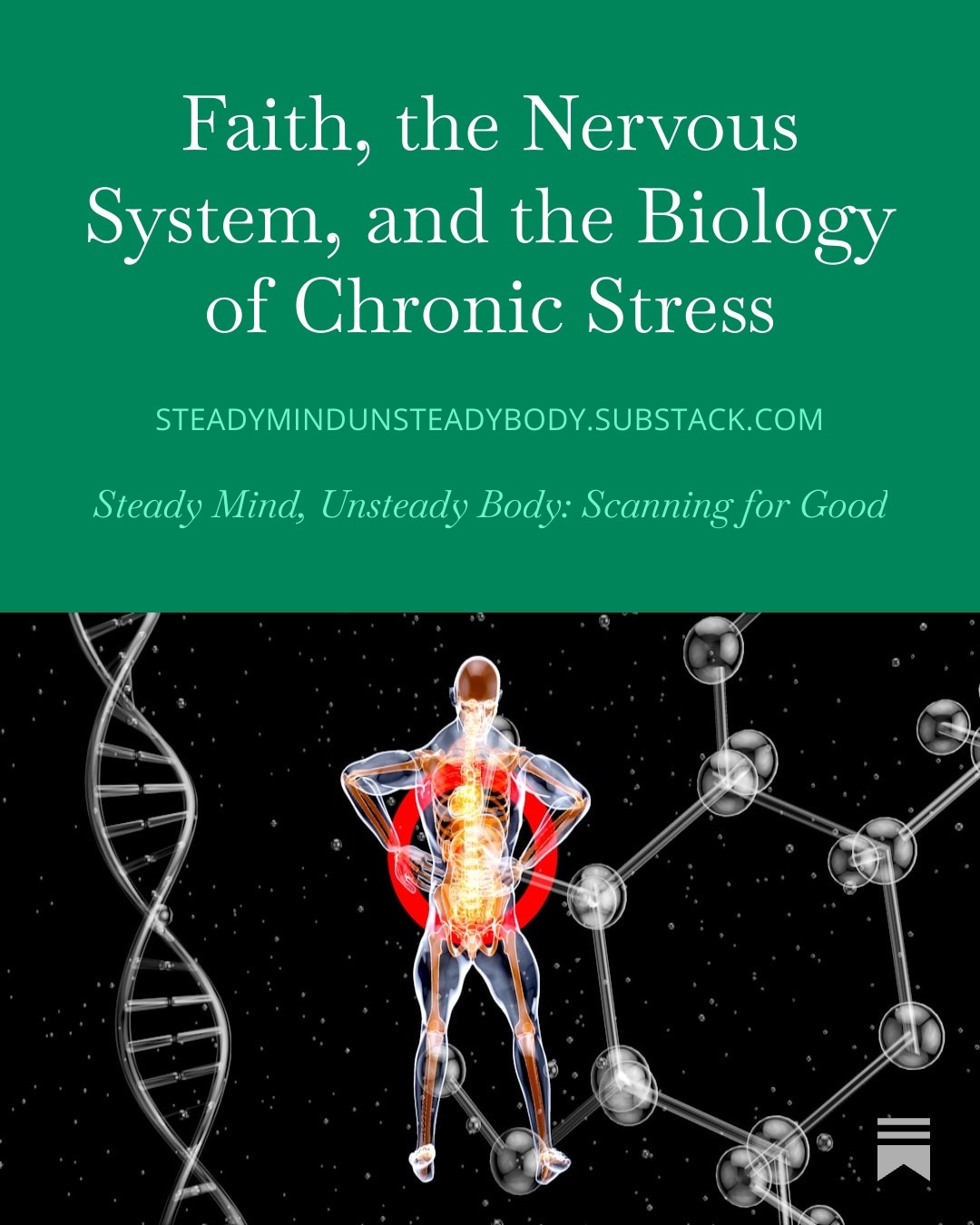
Our autonomic nervous system has two major branches:
• the sympathetic nervous system, often referred to as “fight, flight or freeze”
• the parasympathetic nervous system, often referred to as “rest and digest”
Both systems are necessary. The sympathetic system should not be seen as ‘bad’ or negative in any way. We need it to keep us safe! It was designed by God to help us survive danger. It mobilizes the body for action by increasing alertness, heart rate, muscle tension, and stress hormones. We need this system during emergencies, periods of exertion, and moments requiring focus or protection. The problem arises with the sympathetic system when the body remains stuck there chronically.
The parasympathetic nervous system helps the body restore, digest, repair, recover, and regulate. It supports sleep, healing, emotional regulation, social connection, and restoration after stress. Chronic imbalance between these systems, particularly prolonged sympathetic activation, has been associated with increased inflammation, immune dysregulation, sleep disruption, and amplified pain signaling. This is especially relevant in chronic illness, trauma, autoimmune disease, central sensitization, and persistent pain conditions. Research in psychoneuroimmunology continues to explore how chronic stress physiology affects overall health and inflammatory processes.
For many people living with chronic illness, the nervous system begins to adapt around unpredictability and threat. This is not imaginary, and it is not weakness. Many individuals with chronic pain have experienced years of physical suffering, medical trauma, dismissal, uncertainty, surgeries, frightening symptoms, and exhaustion. Over time, the nervous system learns vigilance. It becomes increasingly efficient at scanning for danger because danger has often been very real.
What is fascinating is that the emotional and spiritual states Scripture consistently encourages are often the same states associated with nervous system regulation and resilience. The Bible repeatedly calls believers toward peace, stillness, gratitude, hope, love, trust, and rest, not because suffering is insignificant, but because chronic fear changes us emotionally, spiritually, and physically over time.
Philippians 4:6–7
“Do not be anxious about anything… but in every situation, by prayer and petition, with thanksgiving, present your requests to God. And the peace of God… will guard your hearts and your minds in Christ Jesus.”
Philippians 4:6-7 describes a movement away from chronic anxiety and toward grounding, gratitude, trust, and peace. Modern neuroscience often describes something surprisingly similar when discussing nervous system regulation and stress recovery. It’s a simple concept, but not necessarily an easy one to achieve!
Research in psychoneuroimmunology has shown that chronic stress can affect immune signaling, inflammatory pathways, hormone balance, pain perception, digestion, and sleep. When the brain perceives ongoing danger, the body adapts accordingly. Cortisol and stress hormones remain elevated, muscles remain tense. The nervous system becomes increasingly vigilant. Digestive and restorative processes may become impaired. In people with chronic pain conditions, the brain can also become increasingly sensitized to pain and threat signals over time.
This is one reason fear can amplify suffering. Not because symptoms are “all in your head,” but because the brain and body are always communicating with one another. Fear teaches the nervous system to remain alert, guarded, and prepared for danger, even during moments that may objectively be safe.
Fear is one of the primary drivers of chronic sympathetic activation. Many people living with chronic illness know this cycle intimately. There is fear of the next flare, fear of worsening symptoms, fear of being dismissed, fear after surgery, fear when pain returns, fear of uncertainty, and fear of losing function or normalcy. The nervous system begins scanning constantly for signs of danger.
Scripture does not dismiss those fears lightly, nor does it shame suffering people for having them. But it does repeatedly invite believers away from perpetual fear and toward trust, peace, rest, and hope. Not denial. Not pretending everything is fine. Rather, learning to remain anchored even while living inside uncertainty. This takes a lifetime of practice and the intentional redirecting of our minds away from our natural impulse to fall back into fear or hopelessness.(Again, simple concept but not easy to carry out.)
The Bible consistently describes the fruit of walking with God as:
• love
• joy
• peace
• patience
• gentleness
• self-control
Galatians 5:22–23
“But the fruit of the Spirit is love, joy, peace, patience, kindness, goodness, faithfulness, gentleness and self-control.”
These are not merely abstract spiritual ideals. Increasingly, neuroscience suggests that many of these states are associated with emotional regulation, resilience, social connection, and healthier nervous system functioning. Practices that support nervous system regulation often overlap with biblical rhythms and spiritual disciplines:
• prayer
• stillness
• gratitude
• meditation on truth
• worship
• emotional honesty
• safe relationships
• compassionate connection
• rest
• hope
Research has shown that contemplative practices, breathing exercises, mindfulness, gratitude practices, and healthy social connection can influence stress physiology and autonomic nervous system regulation. Again, this should not be oversimplified. Prayer is not a replacement for medical care. Breathing exercises do not cure endometriosis or autoimmune disease. Faith is not a guarantee against suffering. But it is becoming increasingly clear that human beings do not function well when trapped in chronic fear, hopelessness, rage, isolation, and unrelenting stress.
Jesus Himself experienced grief, sorrow, anguish, and righteous anger. Christian peace is not emotional numbness, nor is it pretending pain does not exist. Rather, it is the ability to remain rooted and grounded even in the presence of hardship. Scripture often speaks about abiding, resting, remaining, trusting, and being still. (Psalm 46:10 “Be still & know that I am God”, Matthew 11:28 “Come to me, all you who are weary & burdened, and I will give you rest.” That list could go on & on!)
It’s obvious that my pathway to peace is rooted in God’s word. What is yours? How do you find the calm, the peace, the rest you need in your mind that leads to rest in your body? It takes practice and intentionally noticing our thought patterns and fears. If we cannot isolate our thoughts and break them down, we cannot change them.
For many people living with chronic illness, this is not theoretical. Learning to calm the nervous system may become part of learning how to live inside a body that feels unpredictable. And perhaps part of God’s invitation toward peace is not only spiritual comfort, but also a wiser and healthier rhythm for our bodies.
References & Further Reading
• Psychoneuroimmunology overview viaWebMD overview of psychoneuroimmunology
•Overview of psychoneuroimmunology and neuroimmune pathways
•Review on chronic stress, inflammation, and health outcomes (PMC)
•Review on parasympathetic nervous system and recovery
•Meditation and neuroimaging review
•Slow breathing and stress regulation research
• Stephen Porges and Polyvagal Theory research (widely influential though debated in some scientific details)
• Research fields: psychoneuroimmunology, trauma physiology, pain neuroscience, vagal regulation, and central sensitization research
