
Our Daughters Foundation
FAQs: Get Your Endometriosis Questions Answered
From diagnosis delays to treatment options, find straightforward answers to the questions you have about endometriosis.
FAQs: Get Your Endometriosis Questions Answered
From diagnosis delays to treatment options, find straightforward answers to the questions you have about endometriosis.
What is endometriosis, and is it considered a menstrual disease?
Endometriosis is a systemic, inflammatory condition characterized by tissue similar to the lining of the uterus growing in other parts of the body. Endometriosis has been found in every organ. It is not simply a menstrual disease, yet is often mischaracterized as such, even by reputable sources.
Approximately how many people are affected by endometriosis, and what are some common symptoms they may experience?
Endometriosis affects approximately 1 in 10 people born with female reproductive organs. Common symptoms include, but are not limited to, pelvic pain any time during the month, a wide range of GI symptoms, urinary symptoms, fatigue, debilitating periods and more depending on where the endometriosis lesions are located in the body.
What is the average diagnostic delay for endometriosis, and what factors contribute to this delay?
Symptoms often start early in life, but due to cultural taboos, misinformation and a historical lack of emphasis in medical education, they may be ignored or misdiagnosed by caregivers, healthcare consumers and practitioners alike. The average diagnostic delay is 7-10 years.
When can endometriosis symptoms begin, and what percentage of teenagers withchronic pelvic pain may have the condition?
Endometriosis symptoms may begin as early as when puberty starts. Endometriosis symptoms can present before menstruation, during menstruation, and/or after menstruation. An estimated 70% of teens with chronic pelvic pain go on to be later diagnosed with endometriosis.
What constitutes a "red flag" regarding pelvic pain, and what action should be taken if someone experiences this?
Red flag: If you or your patient regularly feels pain during or around periods, and this pain is bad enough to interfere with usual activities, this is a red flag - it is not normal and should be investigated further as soon as possible. (If you do not have this, it doesn't mean that you don't have endometriosis).
Identified risk factors for developing endometriosis.
Risk factors for endometriosis include a mother or sister having the disease (7x increased risk), early onset of menses, short or frequent menstrual cycles, Mullerian abnormalities, autoimmune conditions and more. However, many people develop endo who have none of these risk factors.
Is a hysterectomy considered a cure for endometriosis, and is pregnancy a cure?
Hysterectomy is not a cure for endometriosis. A disease characterized by tissue found outside of the uterus is not cured by removal of the uterus, ovaries and/or tubes and cervix. Over 100,000 hysterectomies are performed each year in the United States for endometriosis and most of them are unnecessary. Neither is pregnancy a cure for endometriosis.
Why are individualized, multi-disciplinary treatment plans needed for endometriosis, and which specialist should be consulted?
People with endometriosis need an individualized, multi-disciplinary treatment plan that may include specialized, incredibly difficult surgery. Most gynecologists are not trained in advanced endometriosis cases. Drug therapy may suppress symptoms, yet it does not eradicate endometriosis. Patients should be referred to an endometriosis specialist.
What are some common co-morbidities associated with endometriosis?
People with endometriosis have an increased risk of co-morbidities including allergies, asthma, and chemical sensitivities, autoimmune diseases such as multiple sclerosis and lupus, chronic fatigue syndrome and fibromyalgia, and certain cancers, such as ovarian and breast cancer.
How does endometriosis impact quality of life beyond physical symptoms, and what holistic approach is recommended?
Endometriosis often reduces quality of life and contributes to psychological distress. Unnecessary delays in diagnosis and gaslighting contribute to the negative mental health impacts of the disease. A holistic approach to care including mental health support can improve quality of life.
What is endometriosis, and is it considered a menstrual disease?
Endometriosis is a systemic, inflammatory condition characterized by tissue similar to the lining of the uterus growing in other parts of the body. Endometriosis has been found in every organ. It is not simply a menstrual disease, yet is often mischaracterized as such, even by reputable sources.
Approximately how many people are affected by endometriosis, and what are some common symptoms they may experience?
Endometriosis affects approximately 1 in 10 people born with female reproductive organs. Common symptoms include, but are not limited to, pelvic pain any time during the month, a wide range of GI symptoms, urinary symptoms, fatigue, debilitating periods and more depending on where the endometriosis lesions are located in the body.
What is the average diagnostic delay for endometriosis, and what factors contribute to this delay?
Symptoms often start early in life, but due to cultural taboos, misinformation and a historical lack of emphasis in medical education, they may be ignored or misdiagnosed by caregivers, healthcare consumers and practitioners alike. The average diagnostic delay is 7-10 years.
When can endometriosis symptoms begin, and what percentage of teenagers withchronic pelvic pain may have the condition?
Endometriosis symptoms may begin as early as when puberty starts. Endometriosis symptoms can present before menstruation, during menstruation, and/or after menstruation. An estimated 70% of teens with chronic pelvic pain go on to be later diagnosed with endometriosis.
What constitutes a "red flag" regarding pelvic pain, and what action should be taken if someone experiences this?
Red flag: If you or your patient regularly feels pain during or around periods, and this pain is bad enough to interfere with usual activities, this is a red flag - it is not normal and should be investigated further as soon as possible. (If you do not have this, it doesn't mean that you don't have endometriosis).
Identified risk factors for developing endometriosis.
Risk factors for endometriosis include a mother or sister having the disease (7x increased risk), early onset of menses, short or frequent menstrual cycles, Mullerian abnormalities, autoimmune conditions and more. However, many people develop endo who have none of these risk factors.
Is a hysterectomy considered a cure for endometriosis, and is pregnancy a cure?
Hysterectomy is not a cure for endometriosis. A disease characterized by tissue found outside of the uterus is not cured by removal of the uterus, ovaries and/or tubes and cervix. Over 100,000 hysterectomies are performed each year in the United States for endometriosis and most of them are unnecessary. Neither is pregnancy a cure for endometriosis.
Why are individualized, multi-disciplinary treatment plans needed for endometriosis, and which specialist should be consulted?
People with endometriosis need an individualized, multi-disciplinary treatment plan that may include specialized, incredibly difficult surgery. Most gynecologists are not trained in advanced endometriosis cases. Drug therapy may suppress symptoms, yet it does not eradicate endometriosis. Patients should be referred to an endometriosis specialist.
What are some common co-morbidities associated with endometriosis?
People with endometriosis have an increased risk of co-morbidities including allergies, asthma, and chemical sensitivities, autoimmune diseases such as multiple sclerosis and lupus, chronic fatigue syndrome and fibromyalgia, and certain cancers, such as ovarian and breast cancer.
How does endometriosis impact quality of life beyond physical symptoms, and what holistic approach is recommended?
Endometriosis often reduces quality of life and contributes to psychological distress. Unnecessary delays in diagnosis and gaslighting contribute to the negative mental health impacts of the disease. A holistic approach to care including mental health support can improve quality of life.
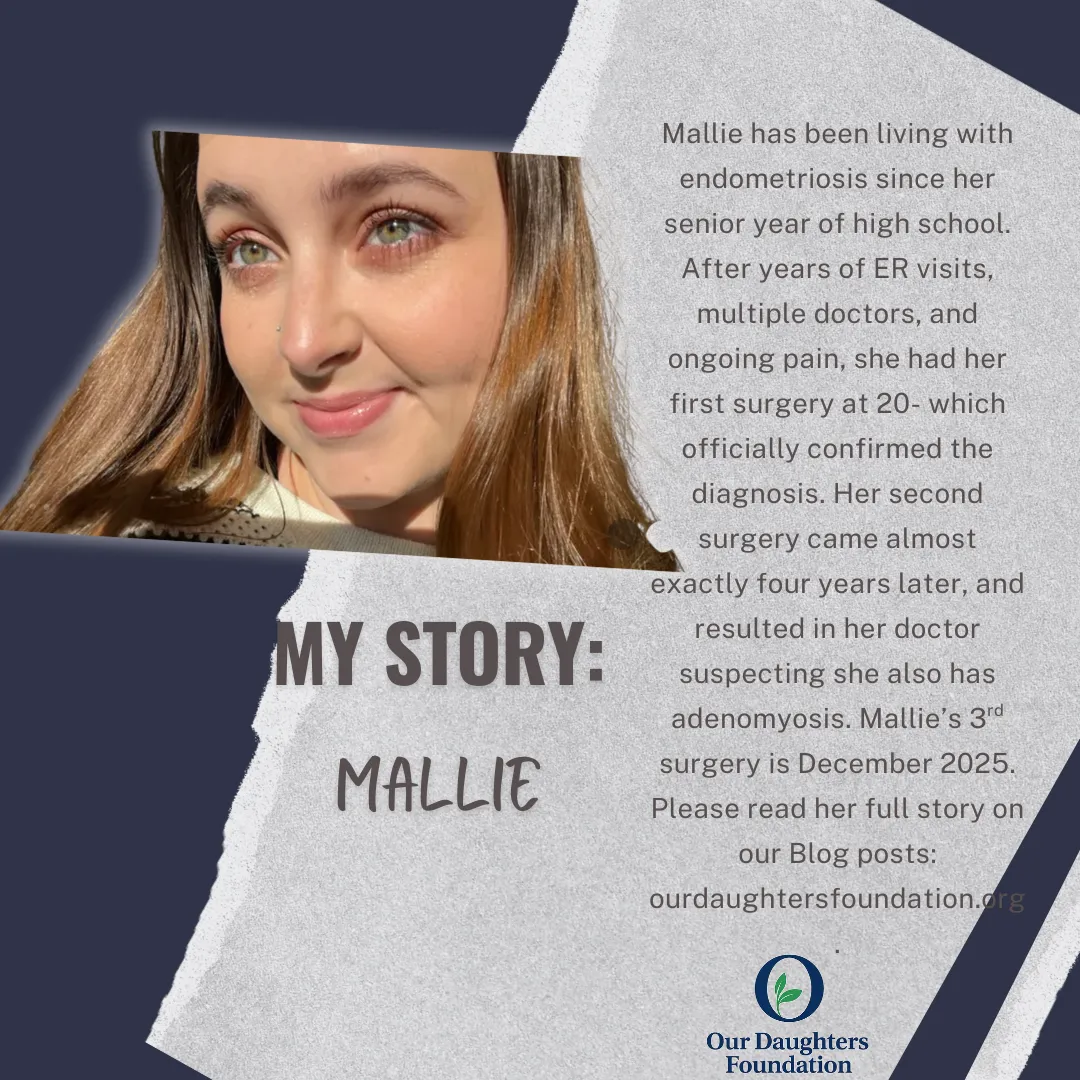
My Story: Mallie

Our Daughters Foundation is honored to support Mallie through her upcoming surgery. For all who have generously donated, Mallie is one of the recipients of your generosity and prayers! Thank you for helping us to make a difference in the lives of so many women & girls!
"My name is Mallie Mims, and I am 26 years old. However, my journey with endometriosis does not start at 26, it started when I was an 18 year old senior in high school. The first time I went to the emergency room for pain, I did not know anything about cysts or endo. To be quite frank, I didn’t really know anything at all about women’s healthcare. That day, I spent half the school day playing hooky curled up in a ball on the floor of my favorite teacher’s classroom. Eventually, I admitted to my mom that I thought she needed to pick me up and take me to the ER. She did, and I soon unknowingly experienced my first case of medical gaslighting. I saw a male doctor who after a few scans, confidently informed my mom and I what the problem was: “you just need to poop. Go home and eat some fiber. Maybe try a laxative.” I felt embarrassed, dramatic, and a bit ashamed to be taking up space in the ER when all I needed was to poop. I remember telling him I did not feel that way, but he sent us home anyways despite my mom and I both feeling like he was wrong. Who were we to question a doctor, though? Surely he knew best. I saw my primary doctor a few weeks later when I got sick (completely unrelated to the prior pain, but I look back now and see it as a blessing that I saw her that day), and offhandedly my mom mentioned our experience with the ER. She looked at us funny and said “explain the pain to me again? Show me where it was.” I did, and she immediately said “it sounds to me like you had ovarian cysts that ruptured.” I did not know it yet at the time, but this was the moment that would change everything.
I started getting cysts more often, and they usually landed me in the ER as I would get high fevers alongside them (something no doctor was ever really able to explain to me besides “maybe it’s just your body doing everything it can to fight back”). I went to college at the University of Alabama at Birmingham, and living in Birmingham I had access to a lot of amazing doctors. I was put on birth control at 19 years old in hopes of stopping the cysts, and for the most part it worked (though I had to try multiple birth controls before landing on one with the least amount of side effects). However, I soon began to notice a different pain. An “always there” pain. Some days it would be sharper, more prominent than others- but there was just always a dull ache no matter what I did. After a while, my OBGYN asked me if I had ever heard of endometriosis. I had not, which is funny to think about now because I can barely remember a time that I wasn’t in pain, or that my life wasn’t revolving around endo. At 20, we decided to go through with a laparoscopy. My doctor said she normally avoided operating on women so young, but that she trusted me and I knew my body. My first surgery was in November of 2019, and when my doctor spoke to my mom while I was in recovery, she told her she was so glad we went through with it because she removed a lot and I would likely need another surgery in a few years, because it would likely grow back. I woke up and immediately asked if she found anything. Then, I cried like a baby when I was told that she did. I wasn’t crazy. My pain was real, and it had a name.
Over the next four years, my pain slowly came back full force. Only this time, it was accompanied by constant bleeding. In March of 2023, I started my period, then… it never ended. In this time, I moved and started seeing a new OBGYN (though I am forever so grateful for my first OB and the care she provided me, as well as the trust she had in me and determination to figure out what was going on), and we decided together that it seemed time for another surgery. My pain was back to being unmanageable, and coupled with the bleeding- I was desperate. Almost exactly four years after my first surgery, I had surgery number two. This time, it was found that my insides were practically glued together with scar tissue, and we discussed the possibility of adenomyosis being a source of my pain as well.
Now just over two years since my second surgery and learning about adenomyosis, I live every single day in pain. The bleeding still has not stopped for longer than few weeks at a time, 2 years and 8 months since it began. I take iron pills because it led me to being borderline anemic. I have since moved to Florida where I work multiple jobs on top of being a full time graduate student at The University of West Florida. I have found a supportive community here, but I cannot properly explain how and why my life revolves around this invisible illness to other people in their 20s who are leading perfectly healthy and normal lives.
I am desperate to find some sort of relief, I can’t keep living like this. Many days, I do well masking my pain. I walk through life doing what I have to do to be successful in work and school, to maintain friendships, to be a present aunt who can do all of the fun and cool things. No one has to know that I am bleeding all the time, or that my base level pain on a really good day is what a healthy person would consider to be a 5 or 6. Other days, I really struggle keeping that mask on. The bleeding may be heavier, the pain more intense, my energy more depleted. On these days, my pain level is what a “normal” person would probably consider to be a 9 or even 10. What else can I do but keep pushing through though, right? Then there are the days where I cannot lift the mask up, cannot force myself out of bed. I have to cancel plans and disappoint people because I cannot physically or mentally function very well. My pain would send a healthier individual to the hospital immediately. I just lay in bed. I cannot keep going like this, faking my way through life. Being in so much pain all the time.
Now at 26, I am going into my third surgery (but first excision). As nervous as I am about the procedure (What if it doesn’t help? What if he finds nothing? What if my pain isn't real?) I also feel as if I am approaching a light at the end of the tunnel. I know this isn’t a cure, but I don’t want to continue feeling as if my life is defined by this disease. I am praying it at least buys me some time to live more pain free and function like a semi-normal 26 year old."

Join Us: Make a Difference Today
Your support can transform lives. Every donation helps us fund research, advocate for better care, and provide essential grants to women facing debilitating conditions.
Join Us: Make a Difference Today
Your support can transform lives. Every donation helps us fund research, advocate for better care, and provide essential grants to women facing debilitating conditions.

